Wednesday, January 6, 2010

Reply to Comment on Jewish Identity

There is more to belonging than just a sense of belonging: the entity to which you feel that you belong must really exist, and you must really be included in it. I belong to the Jewish people even though I do not accept Jewish beliefs, but only because of a practice that rests on those beliefs—which leaves me in an uneasy position.


A few days ago, Rogueregime posted some comments on my first three blog entries to which I think any adequate reply would have to be somewhat lengthy. So here, as another entry rather than a mere comment, is my reply to one of them—his comment on my first entry, “Three Ways of Looking at Being Jewish.” (I expect to reply to his other comments in subsequent entries.)

Responding to my having written, “It may be, for all I know, that my sense of belonging is in fact illusory and superstitious,” Rogueregime asks me:
I’m curious to know more about what you actually experience when you say you feel a “sense of belonging.” Certainly it can’t be illusory if you feel something, right? How does your sense of belonging to the Jewish people differ from, say, your sense of being an American? Is there a difference, and if so, what is it?
I will answer the rhetorical question in the second sentence first, because I think that it will clarify the other matters. Perhaps my expression was not as clear as it could have been, but I take it that someone may have a sense of belonging to some larger entity when in fact he does not, either because the entity does not include him or because it does not exist. Such a possibility is what I meant by an illusory sense of belonging: it is a sense of belonging that does not rest on an actual fact of belonging.

The application to my own case is that I feel that I belong to the Jewish people, but the veracity of that feeling is problematic for me because of my religious doubts. If the grammatically singular term “Jewish people” merely signifies the totality of those who are Jewish by either matrilineal descent or conversion to Judaism, then my belonging to that totality is a natural fact of which I may be assured, but it is hardly a matter of life-shaping importance. Why should it matter that I belong to a group that is defined in such an oddly disjunct manner? Why should a group be so defined?

The only kind of belonging to the Jewish people that could have what I called life-shaping importance, as far as I can make out, is one that derives from religious tradition. For instance, if I accepted the doctrine that the Jewish people (or the nation of Israel, of which the Jews of today are the surviving remnant) is constituted by a covenant with God made at Mount Sinai, then I would have no difficulty attributing a real basis to my sense of belonging, and explaining why and how my belonging matters to the conduct of my life. But I don’t accept that doctrine, and it seems to me unlikely that I shall ever do so.

What actually obtains is the following rather complicated arrangement: I am counted, by a Jewish tradition founded on beliefs that I do not share, as belonging, by virtue of a natural fact of descent, to a people constituted by a hereditary supernatural bond. The fact of my descent provides me, so to speak, with my membership; experience provides me with my sense of belonging; but in what way I actually do belong, and to what exactly I belong, are questions that I have not been able to answer. If this convoluted reasoning gives you a headache, I am sorry, but I can tell you that it is no easier to be the source and object of it!

Rogueregime also asks me what experiences I have in mind when I speak of this “sense of belonging,” and how it differs from my sense of being American. Well, in both cases I regard certain chapters of history to be in some sense “my” history, because they concern an entity to which I belong; in both cases, though there are things in that history that appall me, I tend to prickle when outsiders find fault with my “people”; in both cases, I recognize that my membership conditions my ways of thinking, feeling, and acting; so there are a lot of similarities. But, for one thing, I can imagine circumstances in which I might trade the political part of my American identity, that is, my citizenship, for another national identity, while I cannot imagine circumstances in which I would trade the religious part of my Jewish identity—even though it remains largely, so to speak, unused—for some other religious identity. I don’t know that I can honestly say that I would sooner die, but the feeling seems to me to come pretty close to that. More of that on another occasion, perhaps. The main point is that the Jewish identity, by my subjective estimate, goes deeper.

Finally, Rogueregime posed this question about my proposed three ways of looking at what it is to be Jewish:
Is there not a sense in which one is Jewish not because of anything you think, say or do, but because others see you as a Jew? The fourth “way” would then be “One who other Jews says is a Jew."
Well, the definition (if it can be called that) has an obvious circularity, though an analogous circularity has not deterred some philosophers of recent times from using similar tactics in formulating so-called conventionalist definitions of art. In my estimate, though, this way of looking at Jewish identity, like those definitions, achieves a tidy outcome by trivializing the question that it purports to answer. You illustrate the application of the definition with the case of an Israeli-born friend who recognizes that she counts as Jewish because her mother is Jewish, but to whom the identification has no value or significance. The proposed definition is well suited to the outlook of such a person, but it evades the question of why “other Jews” call someone Jewish. To say that they do so because the person’s mother is Jewish takes us to the question: why do they do that? The answer then must be in terms of Jewish tradition and Jewish law. And then we have to ask what kind of authority such tradition and law have. So if we are seriously trying to explain what a Jew is or what makes someone Jewish, we can’t avoid those difficult questions.


Previous entry: Superstition and Jewish Observance

Next entry: Carl Sagan on Science and Skepticism

Monday, January 4, 2010

Superstition and Jewish Observance

Whether a religious practice is superstitious depends on what its practitioners think that they are doing: one and the same practice may be sustained by different beliefs, some superstitious and some not. Some superstitions are more harmful than others, but superstition is in itself a harm to the mind.

Don’t envy me my fine car! (Found at Flickr.com)

Recently I was searching the Web for the source of a passage from the Reform Jewish liturgy, engraved in my memory by repetition long ago, that had recently been returning to my mind. Through Google Books I found it in the old Union Prayer Book:
May the time not be distant, O God, when Thy name shall be worshiped in all the earth, when unbelief shall disappear and error be no more. Fervently we pray that the day may come when all men shall invoke Thy name, when corruption and evil shall give way to purity and goodness, when superstition shall no longer enslave the mind, nor idolatry blind the eye, when all who dwell on earth shall know that to Thee alone every knee must bend and every tongue give homage. O may all, created in Thine image, recognize that they are brethren, so that, one in spirit and one in fellowship, they may be forever united before Thee. Then shall Thy kingdom be established on earth and the word of Thine ancient seer be fulfilled: The Lord will reign forever and ever. (Union Prayer Book for Jewish Worship (New York: Central Conference of American Rabbis, 1940), 71–72)
To me this passage is sublime music. Not only do its iterations, its balanced phrases, and its elevated diction seduce my ear, but I am touched—deeply—by the faith and hope that it expresses. Yet I do not share that faith and hope. Nothing could be more welcome to me than a day “when superstition shall no longer enslave the mind nor idolatry blind the eye”; but I have no expectation that such a day will ever come. Nor do I see any reason why the alternative to superstition and idolatry should be worship of the supposed one true God, rather than simply the absence of worship. If belief in a creator and ruler of the universe is not itself a superstition, I have yet to understand how it differs from one.

Evidently I am not the only one on whom this passage has made a lasting impression. In searching the Web for it, I had the good fortune to happen on the text of a sermon given in 1997 by Rabbi Barry Block of Temple Beth-El in San Antonio, the title of which is adapted from the quoted passage: “Does Superstition Enslave Our Minds?” I have found much in this sermon to think about, as well as much that leaves me dissatisfied.

Rabbi Block begins by drawing a distinction between harmful superstitions and harmless ones. He offers as an example of a harmless superstition the saying among Yiddish-speaking Jews of the generation of his grandparents, “Tu, tu, kayn aynahora” (the “tu,” I take it, is not a Romance pronoun but a representation of spitting). They said this, according to Block, “to ward off ‘ayin ha-ra,’ the evil eye,” that is, “to prevent ill fortune from befalling us as a result of our having said something too good or too bad.”

(I can’t resist digressing at this point to mention that an equivalent expression existed among the Spanish-speaking Jews of the Ottoman Empire, to which my maternal grandparents and their siblings and cousins belonged. Among them the formula was “Mashalah!”, an expression derived from the Arabic “Mā šāʾ Allāh” and used in many parts of southeastern Europe and the eastern Mediterranean. As I am told, it means “God has willed it” or “Whatever God wills,” and is uttered to ward off the evil eye when notice has been taken of one’s good fortune. My Sephardic great-aunts used it, for example, as congratulation to a mother on her child—not that I appreciated its meaning when I was that child: to me, the word was merely the accompaniment to the dreaded and painful indignity of being firmly pinched on the cheek.)

So that is Block’s example of a harmless superstition: the practice of uttering a formula to ward off the evil eye or its effects. He provides the following anecdote as an example of a harmful superstition:
Some years ago, in Israel, an entire bus full of school children from one town were killed in a terrible accident. In the days following that horrible tragedy, the chief rabbi of the town announced that the accident had occurred because too many of the mezuzzot in town were not kosher. His pronouncement was based on the superstitious notion that the mezuzzah is a mere amulet, a magic spell meant to ward off evil.
In this case, as Block understands it, the superstition is the belief that mezuzot, provided that they are produced and maintained according to halakhic requirements, have the power to keep evil away. Anyone convinced of this, like the rabbi in the story, is likely to conclude that if you fail to maintain your mezuzot properly and misfortune befalls you or members of your household—if, for instance, your children are killed in a bus crash—then you are partly to blame. This superstition is harmful, Block says, first, “because it suggests that victims have brought on their own misfortunes,” and second, because “this kind of superstition can drive Jews away from Judaism. A sophisticated person, hearing that the mezuzzah wards off evil, may well assume that all of Judaism’s teachings are equally silly, and therefore unworthy of our attention.”

Block argues, however, that the fault lies not in the practice of keeping mezuzot but in the meaning that some Jews attribute to that practice. He notes that, while the founders of the Reform movement abandoned the practice as superstitious, it has returned in more recent times, and he proposes that the reasons for the return to the practice be understood in such terms as these:
Each time we enter our home, the mezuzzah reminds us that God should be present there, that we should treat the members of our families, and all who enter our doors, with the love and respect required of us by the words of Torah. When we leave home, and we see our mezuzzah once again, we should be reminded to practice our Judaism along our way, being ethical at work, loving our neighbors as ourselves. If we are so inspired by the mezuzzah, then perhaps it will act like an amulet, after all, even if the scroll inside it isn’t kosher. It won’t prevent bus wrecks, but our lives will be better. We will find blessing in our homes and on our way.

One might raise questions about whether this interpretation of the practice of keeping mezuzot is indeed free of superstition. The business about their reminding us to conduct ourselves ethically and making our lives better through such effects is all very well, but what of the idea of God’s presence and the idea of the Torah as a work of divine origin? For the moment, I want to set such thorny questions aside. Block’s most general point, which I accept, is just that not all superstitions are harmful, and not all ritual practices with which superstitious beliefs have been associated are necessarily superstitious themselves.

What bothers me is that, even with respect to this very general idea, Block’s examples do not seem to me as clear as he apparently would like them to be. Let me start with his discussion of the “evil eye.” Two meanings of this expression (or of “ayin ha-ra”) need to be distinguished. One is the underlying meaning of an envious gaze, or ill will toward another on account of that person’s good fortune. According to Rabbi Louis Jacobs, this is the sense that the expression bears in the Mishnah, in which “the ‘evil eye’ simply denoted that its possessor could not bear with equanimity the good fortune of others.” Taken in this sense, the evil eye is a mere natural phenomenon, an undeniable feature of human psychology. Human beings do, as a matter of plain fact, sometimes bear ill will toward others on account of their good fortune.

Quite distinct from this, though derived from it, is the use of the same expression to signify a supposed power of envious persons to bring actual misfortune upon others by their mere gaze. This sense, Jacobs notes, comes into play in the Babylonian Talmud, from which it passes into later Jewish traditions. (Besides the locus cited by Jacobs, other occurrences in the Talmud are noted by the anonymous purportedly rabbinical author of this piece.) So understood, the expression signifies not a natural phenomenon but something supernatural: a power to make bad things happen to another according to one’s wish by wish alone. Now this surely is superstitious (though for now I defer the question of what makes it so). It is in this sense that Rabbi Block interprets his elders’ utterances of “Kayn aynahora” as gestures to ward off the evil eye. But the interpretation of Rabbi Jacobs, like his Yiddish, is somewhat different:
Even today some people, when praising others, will add: “let it be without the evil eye” (in the Yiddish form, kenenhora), meaning I do not intend my praise to suggest that I am enviously casting a malevolent glance.
On this interpretation, the utterance is not meant to ward off the evil eye, in the supernatural sense, but to disavow the evil eye, in the natural sense. I cannot tell which meaning the users of the Yiddish expression in Block’s recollections had in mind. Indeed, there is no reason to assume that they all understood it the same way, or even that they could have explained what they meant by it, beyond the surface meaning of the words. It is enough that Jacobs’s interpretation shows that we cannot presume, as Block seems to do, that the use of the phrase was a manifestation of superstition. It might have been and it might not have been. In any case, the superstition, if there was any, lies not in the phrase itself or in the use of it, but in the understanding with which it was used.

In saying this, I am, in effect, playing one of Block’s own cards against him: for the distinction between a ritual practice and the superstition associated with it is just the point that he makes about the practice of keeping mezuzot. The trouble I see is that this distinction threatens to undercut the other distinction that he wishes to draw, that between harmless superstitions and harmful ones.

Supposedly, it is harmless to believe that saying “Kayn aynahora” keeps evil away, but harmful to believe that installing and maintaining a mezuzah keeps evil away. The latter point is supposed to be shown by the example of the Israeli rabbi who attributed the accidental death of children to the failure of their parents to maintain their mezuzot properly. But it is easy enough to invent scenarios in which something equally noxious might be said on the basis of the other belief. For instance, suppose that a young couple die in an accident shortly after they are married, and one of the in-laws is blamed for neglecting to say “Kayn aynahora.” The most that can be said to contrast the two examples is that the belief that saying “Kayn aynahora” wards off the evil eye (in the supernatural sense) did not, so far as Block knows—not that it cannot—cause harm, while the belief that keeping a mezuzah wards off misfortune, in the case that he cites, did cause harm.

One way to to link the harm more closely to the belief is to take the line that superstitious beliefs are intrinsically harmful, regardless of their consequences. Superstition, one could argue—and indeed I would argue—is the enslavement of the mind, and to undergo it is a harm whether one knows it or not. (A mind enslaved is impaired by that very bondage from recognizing its condition.) The distinction to be drawn is then not between harmless superstitions and harmful ones, but only between less and more serious forms of mental bondage; perhaps also between ones that do not have harmful effects beyond themselves and ones that do.

So what are we to make of Block’s examples? The practice of saying “Kayn aynahora” and the practice of keeping mezuzot on one’s doorposts alike may be based on a superstitious belief in some instances, and may not be so in other instances; that belief, though harmful in itself qua superstition, may do harm in some instances, or it may not. Does this hold for all Jewish ritual practices? I don’t know. I am, however, pretty sure that under any plausible interpretation, at least some such practices necessarily depend on a belief in their divine origin. It is difficult to conceive of a non-theistic rationale for keeping strict halakha, where that includes behavior that no one knows about but you (as against observance dictated by social pressures within an Orthodox community). So that leads me to the really difficult question: Is belief in God, or more specifically in a God who reveals himself through Torah, itself a superstition?

For the moment, I will only say, as I said at the beginning: if there is a difference between the two, I have never been able to see it. Whether that is because there is no difference or because I have not looked far enough, I am in no position to say. I do hope, however, to say more about this question, as well as about the question of what superstition is, in a subsequent post.


Previous post: IOU for Replies to Comments

Next post: Reply to Comment on Jewish Identity

IOU for Replies to Comments

One hope that I had when I started this blog was that I would learn to write more quickly. I ought to have known better. I am the sort of writer who would fuss over drafts of a shopping list if I had to present it to someone else. Each of my posts so far has cost me at least six hours of composition time. Over the past several days, I have started drafts of several posts, but there is only one on which I have continued to work; and I have surely put more than ten hours into it so far. I think that it is nearly finished, but I can’t be sure of that: new complications have a way of continually emerging.

In the mean time, I have unexpectedly received some rather substantial comments on previous entries from tcs3600 and rogueregime. Each of them merits a thoughtful reply, and, knowing my own habits, I can’t count on being able to post replies to them soon. So my intention is to devote an entry to replying to those comments as soon as I have finished and posted the entry on which I am now working.


Previous entry: Why Are There So Few Non-Orthodox Jewish Blogs?

Next entry: Superstition and Jewish Observance

Tuesday, December 29, 2009

Why Are There So Few Non-Orthodox Jewish Blogs?

Why are there so few bloggers writing about Judaism and Jewishness from a perspective comparable to mine? Is it because too few non-Orthodox Jews care enough about Judaism to write about the topic, or is it because too few of them know enough about Judaism to do so?


(I couldn’t find a good photo of a guy in a kippa at a computer)

Rogueregime, a blogger on Jewish concerns from a Reform perspective, asks in a recent post, “Is anyone else like me out there?
I have found lots of great frum (i.e., religious) and off-the derech (i.e., by former "observant" Jews) blogs out there, and I have even come across some right-wing sites that at the very least are giving me some food for thought. [. . .]

But I'm not finding other blogs written by people like me:  Liberal, Reform Jews searching for a meaningful, authentic connection with the nitty-gritty of our faith.
Now I do not know how specifically Rogueregime intended the words “Liberal” and “Reform.” (Did he mean “Liberal” with a capital L or a small one? If the latter, did he mean liberal in religion or in politics?) Speaking for myself, I would be satisfied to find some blogs in which Jews who are not presently or formerly Orthodox—understood to include the whole range from Modern Orthodox to Ultra-Orthodox—address Jewish concerns. I don’t care whether they are Reform or Conservative or Reconstructionist or Liberal or Renewal or “other” (which would include “unaffiliated”). I would just like to be able to read some thoughtful blog writing about what it means to be Jewish from perspectives that are like mine to the extent of being completely outside of Orthodoxy. I have found Rogueregime’s blog and now the two that he cites in his post (The Reform Shuckle and Mah Rabu). There may be others out there, but, given how hard they have been to find, they cannot exist in the same profusion as Orthodox blogs. Why is that?

The first explanation that came to my mind when I asked myself this question was that there are not many non-Orthodox Jews who find being Jewish to be a topic of sufficient interest for a blog. But I think that a more plausible answer—and it is in some ways an even sadder one—is that there is simply not enough knowledge of Judaism among the non-Orthodox for many of them to blog about Jewish concerns, at least in any very interesting way. I may be overgeneralizing from a narrow experience, but it seems to me that the great majority of non-Orthodox Jews—Jews like me—have at best a smattering of second- and third-hand knowledge of the historical sources of Jewish law and doctrine. Many have not even that. Since most of us do not know Hebrew, let alone Aramaic (which I only recently learned to be the primary language of the Talmud: how ignorant is that? I also ask my non-Orthodox Jewish reader: did you know that?), we don't even have a vocabulary in which to express the pertinent concepts. At least, that is the impression that I get from reading Orthodox blogs, in which Hebrew words and phrases that I never knew are scattered like slang in the conversation of teenagers. (I have recently learned that this mode of expression is called Yeshivish.)

Now it is, of course, a celebrated fact about Jewish tradition that if you want to know what “the Jewish view” on X is, where X is a non-trivial topic, you are asking an essentially unanswerable question. There is no single Jewish view on any topic of significance: what there is is two thousand years of rabbinical disputation. What you have to learn is not what “the Jewish view” is, but how the argument has gone. The trouble is that if you grow up outside of strict Jewish observance, then that tradition is not likely to seem of anything but academic interest to you.

In writing even this much, I have run the risk of talking beyond my knowledge; so I am reluctant to take the topic much further. (Whatever shame there is in knowing that one is ignorant, it is less than the shame of learning that one has talked ignorantly, i.e., made statements with a presumption of knowledge when in fact one did not know what one was talking about.) From this point, I will try only to relate it to my own particular predicament.

I am willing to grant that there may be a form of belief in God that is not superstition. What I cannot conceive to be other than superstition is the attribution of particular events in history to God’s will, particular texts to his authorship (or “inspiration”—a bit of verbal evasion that either means essentially the same thing as authorship or means essentially nothing), or particular laws and observances to his authority. (For two thousand years our rabbis have inveighed against superstition: but it seems to me that in practice what they mean is just superstitions other than their own.)

Now from this point of view, it is difficult to conceive of a rationale for observing halakhah or bringing up one’s children within it. And among Jews who grow up and live without such observance, few are likely to feel much incentive to study the tradition of rabbinical literature and thought. But without study of that tradition, Jews really do not know what Judaism is. In my view, that means that they do not really know what they are. If they do not care about their ignorance, and either abandon Judaism or fail to pass it on to the next generation, they may be throwing away something of immeasurable value. I cannot say that I know that there is something of immeasurable value in Judaism; but I also do not know that there is not. For this reason, I am not willing to throw Judaism away.

So the sum of the matter is this: On the one hand, I cannot understand Judaism otherwise than as being founded on certain beliefs that I find to be inherently superstitious. On the other hand, there may be something of immeasurable value in Judaism. I cannot be in favor of throwing out something that, for all I know, may be of immeasurable value. I also cannot be in favor of superstition. I don’t know where to stand. My only consoling thought is that the Jews of the world—secular or religious, liberal or strict, skeptical or superstitious (but I don’t mean these three pairs of terms as equivalents!)—will go their various ways regardless of what I think or say.


Previous entry: Hocus-Pocus about “Magical Thinking”

Next entry: IOU for Replies to Comments

Hocus-Pocus about “Magical Thinking”

Unquestionably, human beings have a deep and inescapable predisposition to magical thinking; but to identify all instances in which we attribute to things a meaning that goes beyond what we can observe in them as “magical thinking” simply muddies the waters. Ritual actions can have a power that owes nothing to magical beliefs.


In view of how little power we mortals have over what happens in our lives, it is not surprising that we are suckers for magical thinking. Some people manifest this tendency in obvious ways: traditional superstitions about broken mirrors, black cats, saying the name of “the Scottish play” inside a theater, and the like; “lucky” charms and tokens; ritual repetitions of acts that were once accidentally connected with a good outcome; and so on. But magical thinking also has its subtler forms. It is in play when we give vent to chagrin by exclaiming “Just my luck!” To the extent that such an utterance is meant seriously, it implies that a tutelary spirit or individual “luck” orders events for one’s particular disadvantage, or that the events of one’s life are shaped by an invisible power that makes things come out worse for oneself than for others. Of course, no one with a modicum of intellectual self-respect and the capacity for critical reflection seriously affirms such an idea. But the fact remains that, when uncontrollable and unforeseeable events have turned out against us, there is some consolation in entertaining such cosmically self-centered ideas. As I have heard some people say: “I’m not superstitious—just stitious.”

An article by Matthew Hutson, published in Psychology Today in March of 2008, purports to explore this very subject: the persistence of magical thinking even in people who are not aware of engaging in it. (The article is, at the moment of writing, the second hit on Google for “magical thinking,” right after the corresponding entry in Wikipedia.) After presenting an anecdote about a piano formerly owned by John Lennon (about which more in a moment), Hutson says:
Maybe you’re not a Beatles fan. Maybe you even hate peace and love. But you are wired to find meaning in the world, a predisposition that leaves you with less control over your beliefs than you may think. Even if you’re a hard-core atheist who walks under ladders and pronounces “new age” like “sewage,” you believe in magic.
Hutson’s first positive assertion—that we are all “wired to find meaning in the world”—is, I take it, indisputable and unobjectionable (apart perhaps from the ugliness of the computer-geek metaphor of describing human beings as being “wired” somehow). His second assertion, that this predisposition “leaves you with less control over your beliefs than you may think,” and that, even if you are of a skeptical bent, you believe in magic, is rather disturbing, at least to a skeptically minded person like me. Reading that claim makes me keen to know what evidence he has for such a bold assertion. Here is a sample of what Hutson offers:
Often we don’t even register our wacky beliefs. Seeing causality in coincidence can happen even before we have a chance to think about it; the misfiring is sometimes perceptual rather than rational. “Consider what happens when you honk your horn, and just at that moment a streetlight goes out,” observes Brian Scholl, director of Yale’s Perception and Cognition Laboratory. “You may never for a moment believe that your honk caused the light to go out, but you will irresistibly perceive that causal relation. The fact remains that our visual systems refuse to believe in coincidences.” Our overeager eyes, in effect, lay the groundwork for more detailed superstitious ideation. And it turns out that no matter how rational people consider themselves, if they place a high value on hunches they are hard-pressed to hit a baby’s photo on a dartboard. On some level they’re equating image with reality. Even our aim falls prey to intuition.
The first observation is that if a streetlight goes out just when you honk your horn, you “irresistibly perceive” a causal connection in virtue of the nature of your “visual system,” no matter how well aware you are that there is none. This is supposed to show that your “visual system” “believes” in a causal connection. The second observation is that if you throw darts at a photo of a baby on a dart board, your aim will be bad: this is supposed to show that “on some level” you are equating the photo of a baby with a baby.

Both arguments are utter rubbish. They turn on the strategic use of conceptual slippage. Of course, two events occurring at the same time may strike me as if they were causally connected; I might say that they look to me as if they were causally connected. But this is not tantamount to my believing that the events are causally connected.

In fact, Scholl (the psychologist quoted within the passage) seems to be aware of this point; he tries to avoid absurdity by saying that my visual system “believes” in a connection, even when I do not. But it makes no sense to attribute beliefs to a mere part of a human being. Whatever it means to say that my “visual system” “believes” something (if it means anything coherent at all), that does not mean that I believe it. The argument therefore gives no evidence of the occurrence of magical thinking. Similarly, in the case of the dart board, all that has been shown is that the photo has an effect on people that is similar to the effect of an actual baby: no evidence whatever has been provided to support the unverifiable and obscurantistic claim that “on some level” people believe that the photo is a baby.

Hutson’s entire argument rests on equivocations of this nature. His most villainous equivocation is perpetrated with the very term that forms the title of the article, “magical thinking”; for he uses it to cover both belief in unobservable causal connections and the attribution to things of a meaning that is not grounded in observable causal connections. By means of this conflation, he illegitimately counts instances of the latter (invested meaning) as instances of the former (magical thinking properly so called). Consider the anecdote with which the article opens, concerning a tour made by John Lennon’s piano years after the musician’s death.
“It gives off his spirit, and what he believed in, and what he preached for many years,” says Caroline True, the tour director and a colleague of the Steinway’s current owner, singer George Michael. Free of velvet ropes, it could be touched or played by anyone. According to Libra LaGrone, whose home was destroyed by Hurricane Katrina, “It was like sleeping in your grandpa’s sweatshirt at night. Familiar, beautiful, and personal.”

“I never went anywhere saying this is a magic piano and it’s going to cure your ills,” True says. But she consistently saw even the most skeptical hearts warm to the experience—even in Virginia, where the piano landed just a month after the massacre [at Virginia Tech]. “I had no idea an inanimate object could give people so much.”
Where exactly is magical thinking supposed to be evident in this account? Hutson never says, though he presents the story as an illustration. He seems to think the presence of magical thinking too obvious to require explanation. Perhaps he reasons that, since the piano is not John Lennon himself, or an image or a recording of him, but is merely a piano that was once owned and used by him, anybody who regards it as anything other than an old piano must believe that Lennon is somehow actually present in it.

Any anthropologist who made such a leap in interpreting human behavior would be derided as incompetent. So I suggest a more charitable interpretation: Hutson has conflated the common human practice of endowing objects with a significance that goes beyond what can be observed in them with magical thinking properly so called. I find this interpretation confirmed by what he says further on in the article:
To some, John Lennon’s piano is sacred. Most married people consider their wedding rings sacred. Kids with no notion of sanctity will bust a lung wailing over their lost blanky. Personal investment in inanimate objects might delicately be called sentimentality, but what else is it if not magical thinking? There’s some invisible meaning attached to these things: an essence. A wedding ring or a childhood blanket could be replaced by identical or near-identical ones, but those impostors just wouldn’t be the same.

Hutson’s rhetorical question “What else is it if not magical thinking?” is either disingenuous or obtuse. The question of the nature of our attachment to particular possessions, when that attachment is grounded in the history of the items rather than in their observable characteristics, deserves to be posed seriously, not used as a mere rhetorical device for counting all instances of such attachment without examination as “magical thinking.” No doubt, some people do engage in magical thinking with regard to such things: some may believe that the items in question bring them luck, or that getting rid of them would bring disaster, or that they allow them to communicate with the spirit of the former owner, or things of that nature. But not everyone who cherishes a possession in this way holds such beliefs. I doubt that even most such people do.

A simple instance: A friend of mine once gave me a small stuffed toy as a kind of joke gift. For a long time, I kept it atop a dresser, where it would gather dust, because I had no particular use for it and it simply did not fit in with anything else that I own. After a few years, when I was cleaning the clutter out of my apartment, I included it with the items to be given away. Now for all that I knew, my friend might have forgotten that she ever gave me such a gift, or might not care the least whether I kept it or dumped it; I certainly hoped that, if she knew of my discarding the toy, she would not blame me for it. But I could not help feeling, as I think anyone in such a position would feel, that the act of getting rid of the toy had about it something of a desecration. Why? Because the toy was given to me by a friend and was a palpable token of our friendship.

I don’t think that anyone will have any difficulty understanding this fact. But to attribute my feelings about the toy to “magical thinking,” a term that properly designates a belief in supernatural agencies and occult causal connections, is groundless. Hutson’s leaps from observations on how people endow physical tokens with meaning to the conclusion that they are indulging in magical thinking is as groundless and irrational as (genuine) magical thinking itself.

One thing that particularly annoys me about people who reason in the way that Hutson does is that, while they claim to be uncovering the depths of irrationality in human beings, the arguments that they use actually presuppose an implausibly and dogmatically rationalistic way of regarding human behavior. They see people behave in ways that don’t make sense if you try to explain them as attempts to secure particular ends by means of observable causal connections. You might think that the logical conclusion to draw is that the behavior in question simply is not an attempt to secure any end beyond itself. But instead of drawing that conclusion, they conclude that the behavior must be an attempt to secure an end based on belief in an unobservable causal connection. I don’t deny that some people do things of this nature; but to interpret all ritualistic behavior by human beings in this way is a mere rationalistic prejudice. Hutson’s thinking not only makes magical thinking seem much more pervasive than it is, but gives too little credit to the inherent power and significance of ritual practices.


Bibliographical note

Readers of Ludwig Wittgenstein’s “Remarks on Frazer’s Golden Bough” (available in the volume Philosophical Occasions, 1912–1951, edited by James C. Klagge and Alfred Nordmann (Indianapolis: Hackett, 1993), 115–55) will recognize its influence on my critique of Hutson. For instance: “Burning in effigy. Kissing the picture of one’s beloved. That is obviously not based on the belief that it will have some specific effect on the object which the picture represents. It aims at satisfaction and achieves it. Or rather: it aims at nothing at all; we just behave this way and then we feel satisfied” (123). Or this remark, which, whether or not it is fair to Frazer, is the best analysis I have seen of a certain kind of scientistic obtuseness: “His explanations of primitive practices are much cruder than the meaning of these practices themselves” (131). My observations on the senselessness of imputing beliefs to visual systems is also indebted to the work of Wittgenstein, by way of the work of his disciple Peter Hacker. See M. R. Bennett and P. M. S. Hacker, Philosophical Foundations of Neuroscience (Oxford: Blackwell, 2003), ch. 3, “The Mereological Fallacy in Neuroscience.”


Previous post: On Being Skeptical

Next post: Why Are There So Few Non-Orthodox Jewish Blogs?

Sunday, December 27, 2009

On Being Skeptical

“Skepticism” can signify a tendency to doubt, a devotion to critical inquiry, or a certain popular movement advocating scientific and critical thinking against magical and pseudo-scientific thinking. There is something of all three in the writer of this weblog.


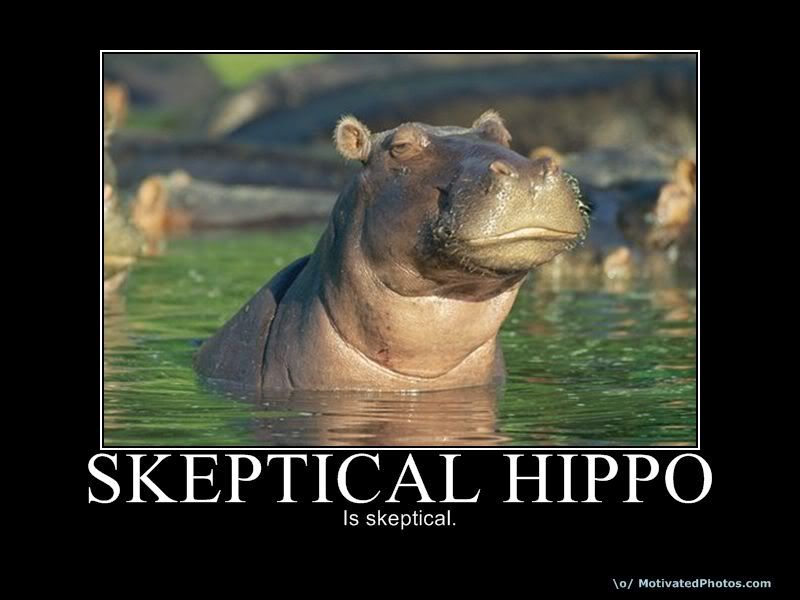
Skeptical Hippo

The word “skeptical,” along with its relatives “skeptic” and “skepticism,” belongs to the set of words that have found their way from the vernacular of an ancient language into the jargon of philosophers, and from there back into the vernacular of modern languages, with shifts of sense occurring at each turn. In classical Greek, the noun σκέψις (skepsis), as glossed by Liddell and Scott (see bibliographical note below), bears the sense of “examination, speculation, consideration” and “inquiry into, speculation on,” while the adjective σκεπτικός (skeptikos) has the sense of “thoughtful, reflective.” The word only took on a sense recognizably close to its modern one in consequence of its being adopted by certain philosophers who made the raising of doubts their primary occupation—the original “skeptics” of ancient Greece.

It is difficult to say much about the ancient skeptics without getting involved in thorny problems of interpretation. (Anyone interested in reading more about them may consult the articles in The Stanford Encyclopedia of Philosophy and The Internet Encyclopedia of Philosophy.) I will add only this much about them, that in applying the word “skeptical” (or rather its Greek antecedent) to themselves they meant to describe themselves as inquiring, but they have become better known by their doubting, and it is the latter trait that has primarily been understood by the word in its popular use ever since. The river-dwelling quadruped shown above may not be convinced of this, but the image macro as a whole supports my point.

Lately there has arisen a popular movement that has restored to the word “skeptic” something of its original positive sense. A skeptic in this sense is a proponent and practitioner of critical thinking and of the application of scientific method to extraordinary claims. The term “extraordinary claims,” made popular by Carl Sagan’s famous saying, “Extraordinary claims require extraordinary evidence,” is not exactly a technical one, but as it is used by skeptics of this stripe, it seems to have a somewhat specialized meaning. My understanding is that it signifies claims that are contrary to well-founded scientific conclusions or to extensive common experience, such as those concerning ghosts, extraterrestrial visitors, creationism, much so-called alternative medicine, and so on.

On this understanding, a skeptic is not, per se, someone who finds these claims incredible, but someone whose estimate of them is based on a critical and scientific examination of the evidence. It just happens that in the vast majority of instances, such examination leads to the conclusion that the claims are unfounded. The Web site of the Skeptics’ Society puts the matter thus:
Skepticism is a provisional approach to claims. It is the application of reason to any and all ideas — no sacred cows allowed. In other words, skepticism is a method, not a position. Ideally, skeptics do not go into an investigation closed to the possibility that a phenomenon might be real or that a claim might be true. When we say we are “skeptical,” we mean that we must see compelling evidence before we believe.

In describing myself as a “skeptical Jew,” I had several meanings in mind. First, like the skeptics of the Skeptics’ Society, I am a proponent of critical thinking and scientific rationality, and an opponent of superstition and pseudo-science. So I am at least a fellow-traveler of the skeptical movement. Second, even before I had much idea of what critical thinking or scientific method was, I was devoted to the critical examination of important claims and assumptions. So I am in that respect a skeptic by natural disposition. And third, I am a skeptical, both in the special sense of applying critical reason and in the popular sense of being doubtful, where theistic and eschatological claims, such as those of Judaism, are concerned. I expect to exhibit something of my skepticism in each of these respects in my future posts in this blog. The third respect, though, is the one that I expect to get the most exercise.


Bibliographical note


“Liddell and Scott”: Henry George Liddell and Robert Scott, A Greek–English Lexicon, revised and augmented throughout by Sir Henry Stuart Jones with the assistance of Roderick McKenzie (Oxford: Clarendon Press, 1940); on line at the Perseus Digital Library. From this hefty work of reference two abridgements were derived, one of about half the size of the original and the other somewhat smaller than that. The three are known to students of classics as “Big Liddell” (the name is stressed on the first syllable), “Middle Liddell,” and “Little Liddell.”


Previous post: Three Ways of Looking at Being Jewish

Next post: Hocus-Pocus about “Magical Thinking”

Three Ways of Looking at Being Jewish

My first version of the title of this post was “Three Ways of Looking at a Jew.” The parody held some charm for me (if you don't get the allusion, look here), but I chose to replace it with a title that better reflects the actual content to follow. The three aspects are: belonging to the Jewish people, practicing Judaism, and adhering to Jewish beliefs. Relations among the three are complicated.


Here are three ways in which one might think of what a Jew is:
  1. One who belongs to the Jewish people.
  2. One who practices Judaism.
  3. One who adheres to the Jewish faith.
It would be nice, wouldn’t it—I mean, as far as intellectual comfort is concerned—if these three descriptions invariably coincided. For if they did, then any question of what it means to be a Jew would be, in the end, academic: a potentially interesting matter to think about, but not an urgent or a necessary one, and above all not a troubling one. But I cannot imagine a world in which those three descriptions invariably coincide—other than, I suppose, a world without Jews.

I could not define any of those three items without entangling myself in controversies that would soon take me out of my depth. Nonetheless, I believe that I fit the first description—“one who belongs to the Jewish people”—and that this by itself makes me a Jew. Or perhaps I should say that my being a Jew makes me a member of the Jewish people rather than the other way around. In any case, the fact that I practice almost no Jewish observances and accept none of the theistic and eschatological beliefs of Judaism does not raise any doubt in my mind about my Jewish identity. (I suppose that in the eyes of Orthodox Jews I would be a kind of virtual goy; but, since I was born of a Jewish mother, they would still count me as Jewish under halakhah.)

It may seem, then, that for me the question of what it means to be a Jew should be academic after all. For if I am sure that I am Jewish, regardless of my being without Jewish observances and beliefs, then what need is there for me to perplex myself about these various aspects of being Jewish? Let the believing Jews worry about such things!

But the matter is not so simple. For one thing, although the primary criterion of belonging to the Jewish people, and thus of being a Jew, is that one is born of a Jewish mother, this criterion is itself a product of religious law. So one who takes himself to belong by birth to the Jewish people, as I do, is thereby appealing to religious law, and thus to religious practice and belief. To be sure, one can belong to the Jewish people without believing or practicing Judaism, as one can believe without belonging or practicing, or practice without belonging or believing: the three items can occur independently of one another. But they cannot be conceived independently of one another. So the non-believing, non-practicing Jew who considers himself to belong to the Jewish people is thereby entangled in a problem that is anything but academic: how can I belong to a people defined by a religious law that I do not myself accept? If I don't accept the law—if I neither observe it nor accept the beliefs on which its authority rests—do I in fact belong?

One possible response to this problem is simply to give up the idea that one belongs to the Jewish people. Indeed, to be consistent, one would have to deny that there is any such thing as the Jewish people. One would not deny, of course, that there are Jewish people, that is, persons of Jewish descent, most of whom happen to profess a certain religion called Judaism; but one would have to deny that they constitute a people in any serious sense—a sense weighty enough to generate an obligation to continue the traditions of that people, for instance.

I know that many Jews do take this route. For them, being “Jewish” is purely a matter of descent, like being “Irish” or “Italian” as Americans commonly use those terms, meaning that one has forebears of the nationality in question. Such a way of regarding Jewish identity seems coherent and rationally defensible, at least on its face. That is more than I can say for the option that I have taken, that of regarding myself as a member of the Jewish people without accepting the religious beliefs or, for the most part (more on this qualification later), the practices on which that identification seems to rest.

It may be, for all I know, that my sense of belonging is in fact illusory and superstitious. But it may also be that it is not, and that I have simply been unable to figure out what it does in fact rest on. It could rest on accidents of personal history and emotional association, or it could rest on something immeasurably precious that I have so far failed to comprehend. The best bet for me, in my estimation, is simply to press on with my inquiries. A skeptic, as I use the term, is not simply one who doubts, but one who requires sufficient reason for any proposed conclusion in a matter that admits of reasonable doubt. In the present instance, that includes requiring rational substantiation of my own doubts: they may be founded on insights, or on blind spots. Thus I remain a skeptical Jew.


Next entry: On Being Skeptical